1. You’ve Landed in Nairobi. Now What?
Your flight touches down at Jomo Kenyatta International Airport, immigration takes forty minutes, and somewhere between baggage claim and the arrivals hall you have to make a decision: how are you actually going to get around Kenya for the next week or two? For most travelers, the answer comes down to a choice between car hire in Nairobi and everything else — taxis, ride-hailing apps, tour vans, or public transport.
This guide is built around that decision, and the ones that follow it: which vehicle to choose, what a rental actually costs once fuel and insurance are added in, how the booking process works from first enquiry to drop-off, and which routes make the most sense once you’re behind the wheel. Rather than a general overview, think of this as a field guide for car rental in Kenya, written around real budgets, real mistakes other travelers have made, and a real sample itinerary you could follow almost exactly as written.

2. Who Actually Needs to Hire a Car in Kenya?
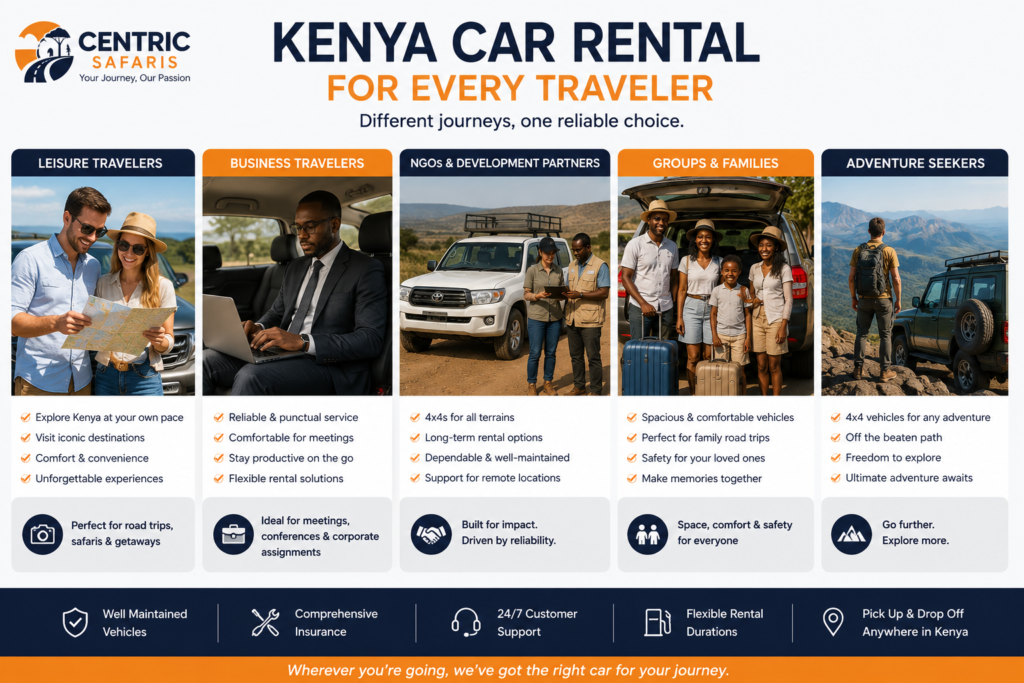
Not every traveler needs the same vehicle or booking style. Before comparing prices, it helps to see where you fit — the table below matches common traveler types to the car hire approach that tends to suit them best.
| Traveler Type | Typical Need | Best-Fit Option |
| Safari-bound traveler | Multi-day trip to the Mara, Amboseli, or Tsavo | Chauffeur-driven 4×4 Land Cruiser |
| Business executive | Meetings across Nairobi over a few days | Self-drive sedan, or chauffeured executive car |
| Family or group of 4+ | Moving several people and luggage together | Self-drive or chauffeur-driven minivan |
| Long-stay expat / NGO worker | Weeks or months based in Nairobi | Long-term self-drive rental contract |
| Weekend road-tripper | Short getaway to Naivasha or Nakuru | Self-drive SUV |
The safari-bound traveler and the weekend road-tripper both want a vehicle capable of leaving tarmac roads, but their trip length and driver preference usually differ enough to change which package makes financial sense — a point we come back to in the budget breakdowns further down this page. Business travelers and long-stay residents, on the other hand, are usually better served by simpler self-drive sedans and a rental contract structured around weekly or monthly billing rather than a daily safari-style quote.
3. The 5-Step Car Hire Process, From Enquiry to Drop-Off
Most first-time renters aren’t sure what order these decisions actually happen in. Here’s the practical sequence, step by step.
Step 1 — Decide Between Self-Drive and Chauffeur-Driven
This is the single decision that shapes everything else about your booking — price, documents required, and which routes are realistic. Self-drive suits confident drivers staying mainly in Nairobi; chauffeur-driven car rental in Kenya suits almost everyone heading out to a national park or unfamiliar rural route.
Step 2 — Pick Your Pickup Point
Nairobi CBD, Westlands, JKIA, and Wilson Airport are the four most common pickup points, each suited to a different arrival scenario. Confirm this early, since it can affect whether a delivery or airport surcharge applies to your quote.
Step 3 — Gather Your Documents
For self-drive, this means a valid driving licence, an International Driving Permit for most non-Kenyan licences, and a passport or national ID. Chauffeur-driven bookings need far less paperwork from you, since a licensed local driver takes the wheel.
Step 4 — Check Insurance and Walk Around the Vehicle
Before you sign anything, confirm what the insurance excess actually is, and walk around the car noting any existing scratches, dents, or worn tyres. A quick set of photos on your phone protects you at drop-off.
Step 5 — Hit the Road, and Know the Return Process
Confirm the fuel policy (almost always full-to-full), your mileage allowance if one applies, and where and when the vehicle needs to be returned. Ask what happens if you’re delayed — flexible drop-off windows are common but not universal.

4. Fleet Spotlight: What You Can Actually Drive
Rather than a generic list of categories, here’s what each option actually feels like to drive and who it tends to suit best — useful context once you’re comparing quotes side by side.
The City Runabout
A compact, fuel-efficient sedan such as a Toyota Axio or similar — easy to park, cheap to run, and perfectly suited to Nairobi’s paved roads and daily errands.
The All-Rounder SUV
A Toyota RAV4 or comparable crossover, with enough ground clearance for light off-road sections and enough boot space for a week’s luggage — a strong middle-ground choice for road trips that mix tarmac and gravel.
The Safari Workhorse
The 4×4 Land Cruiser, usually fitted with a pop-up roof for game viewing, is the standard vehicle for the Maasai Mara, Amboseli, and Tsavo. Built for unpaved park roads and river crossings that would strand a standard sedan.
The Group Mover
A 7- to 9-seat minivan for families and small groups travelling together, usually working out cheaper per person than splitting into two smaller vehicles.
The VIP Option
A premium sedan or SUV, almost always chauffeur-driven, booked for weddings, corporate transport, or executive airport transfers where comfort and presentation matter as much as the drive itself.

5. What It Really Costs: Three Real Trip Budgets
Published daily rates rarely tell the whole story once fuel, insurance, and driver costs are added. Here are three realistic budget breakdowns for common trip types.
Budget 1 — 3-Day Nairobi City Stay (Self-Drive Economy Sedan)
| Line Item | Estimated Cost (USD) |
| Vehicle hire, 3 days @ ~$50/day | $150 |
| Basic insurance | $15 |
| Estimated fuel (city driving) | $25 |
| Estimated total | $190 |
Budget 2 — 7-Day Self-Drive Safari Loop (4×4 Land Cruiser)
| Line Item | Estimated Cost (USD) |
| Vehicle hire, 7 days @ ~$150/day | $1050 |
| Comprehensive insurance | $70 |
| Estimated fuel (mixed tarmac/park roads) | $180 |
| Park-road mileage buffer | $40 |
| Estimated total | $1,340 |
Budget 3 — 5-Day Chauffeured Coastal Road Trip (SUV + Driver)
| Line Item | Estimated Cost (USD) |
| Vehicle + driver, 5 days @ ~$170/day | $850 |
| Driver accommodation & meals allowance | $100 |
| Comprehensive insurance | $50 |
| Estimated fuel (Nairobi–coast route) | $150 |
| Estimated total | $1 |
These figures are illustrative starting points, not fixed quotes — actual pricing depends on season, exact vehicle, and current fuel prices. Request a written quote from Centric Safaris before booking so every line item is confirmed upfront.
6. Car Hire vs Ride-Hailing vs Public Transport: A Real Comparison
| Factor | Rental Car | Ride-Hailing App | Matatu / Public Bus |
| Cost for 3 days in Nairobi | $120–$200 | $150–$300+ | $10–$20 |
| Cost for a Nairobi–Maasai Mara round trip | $1,000–$1,300 (incl. driver, fuel) | Rarely offered / very high | Not practical for park access |
| Schedule flexibility | Full control | Booking-dependent | Fixed routes and times |
| Access to national parks | Yes, especially with 4×4 | No | No |
| Comfort on long routes | High | Variable by driver/car | Low |
Public transport wins on raw cost for short city trips, and ride-hailing apps are convenient for single point-to-point journeys within Nairobi. Neither option scales well once a national park or multi-day itinerary enters the picture — which is where car rental in Kenya consistently becomes the more practical, and often cheaper, choice per day of travel.
7. Where to Collect Your Car in Nairobi
- Nairobi CBD — central, close to offices and hotels, standard rates apply
- Westlands — convenient if you’re staying at a hotel or serviced apartment in the area
- JKIA (Jomo Kenyatta International Airport) — collect your vehicle straight after landing; an airport surcharge may apply
- Wilson Airport — useful if you’re connecting onward to a domestic safari flight
- Hotel or doorstep delivery — the vehicle is brought to you, usually for a small delivery fee
- Upcountry towns (Naivasha, Nakuru, Mombasa, Kisumu) — available for one-way rentals that end your trip somewhere other than Nairobi
8. Seven Mistakes That Cost Kenya Car Hire Customers Money
1. Booking without checking the insurance excess — a cheap daily rate can hide a large out-of-pocket liability if something goes wrong.
2. Ignoring mileage caps on a long safari — park routes rack up kilometres fast, and overage charges add up.
3. Choosing a 2WD sedan for park roads — a beautiful daily rate is no help when the car is stuck in mud outside the Mara gate.
4. Not confirming the fuel policy upfront — full-to-full is standard, but assuming this without asking has caught travelers out.
5. Skipping the pre-rental vehicle inspection — undocumented existing damage is the single most common source of deposit disputes.
6. Underestimating Nairobi rush hour — journeys across the city can take three times longer than map estimates suggest during peak traffic.
7. Not asking about roadside assistance — breakdowns happen, and knowing the response plan before you’re on a remote road matters more than the daily rate.
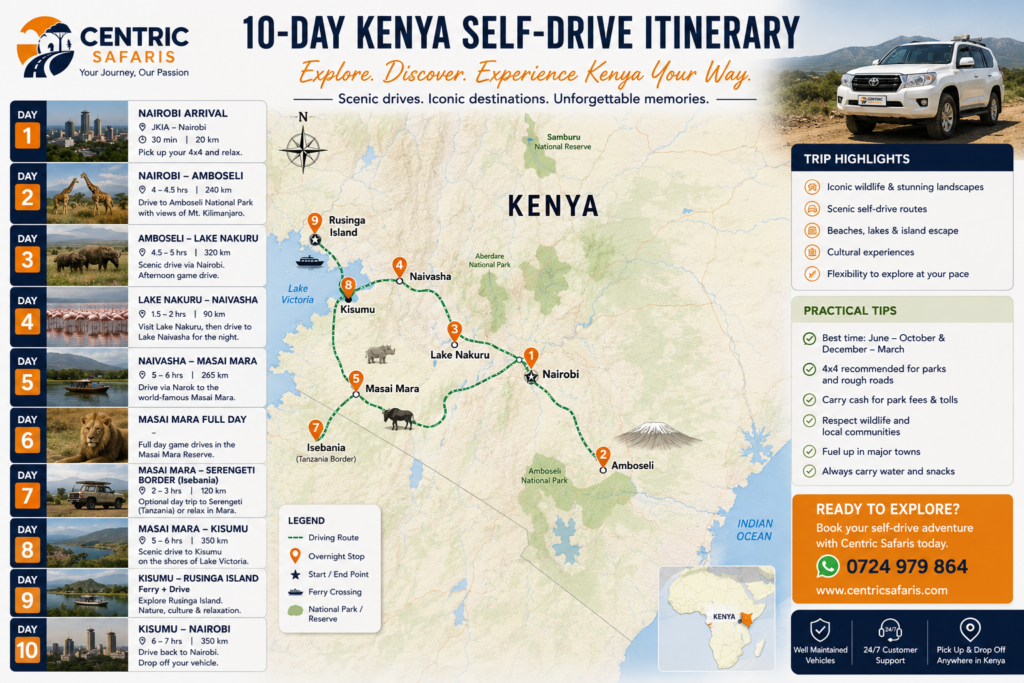
9. Sample 10-Day Self-Drive Itinerary Using a Rental Car
| Days | Route / Stop | Notes |
| Days 1–2 | Nairobi | Collect vehicle, city orientation, Nairobi National Park visit |
| Days 3–5 | Nairobi → Maasai Mara | 3 nights in the reserve; 4×4 strongly recommended |
| Day 6 | Maasai Mara → Lake Nakuru | Rift Valley scenery, wildlife viewing en route |
| Days 7–8 | Lake Nakuru → Naivasha | Relaxed pace, boat rides and Hell’s Gate National Park |
| Days 9–10 | Naivasha → Nairobi (or onward to Amboseli) | Return vehicle in Nairobi, or extend toward Amboseli |
This loop works well with either a self-drive 4×4 for experienced drivers or a chauffeur-driven vehicle for a more relaxed pace — Centric Safaris can quote either version of this exact route on request.
10. Insurance, Safety, and What’s Actually Covered
Rental insurance in Kenya typically comes in layers, and it’s worth understanding what each one actually protects:
- Collision Damage Waiver (CDW) — limits your liability for damage to the rental vehicle itself, usually down to a set excess amount
- Theft protection — covers the vehicle if it’s stolen, again usually subject to an excess
- Third-party liability — covers damage or injury you cause to others
- Personal accident cover — covers medical costs for the driver and passengers in an accident
- Roadside assistance — covers breakdown recovery, particularly important on rural and park routes
Ask directly what the excess is for each layer of cover, and whether it can be reduced by paying a higher daily premium — this single question often has the biggest impact on your worst-case financial exposure.
It’s also worth checking whether cover changes once you leave paved roads. Some policies quietly exclude damage sustained on unmarked park tracks, which matters a great deal if your route includes the Mara or Amboseli rather than city driving alone.
11. What Sets Centric Safaris Apart
Plenty of operators offer car hire in Nairobi; fewer combine it with genuine safari logistics experience. Centric Safaris runs a maintained fleet built around real Kenyan road conditions, from Nairobi tarmac to Mara Triangle mud, and prices every quote with insurance excess and mileage terms spelled out before you pay a deposit.
If you’re weighing self-drive against chauffeur-driven car rental, our team will talk through your route rather than just quoting a price. Heading to the parks specifically? Ask about our 4×4 safari vehicle hire fleet. Need a smoother arrival? Our JKIA and Wilson Airport pickup service gets you on the road within minutes of landing, and our tailor-made Kenya safari packages can bundle the vehicle into a complete, planned trip.
Not sure which option fits your trip? Talk to our team directly and we’ll build a quote around your actual itinerary, not a generic daily rate.
→ Tell Us Your Route — Get a Tailored Car Hire Quote from Centric Safaris
12. Frequently Asked Questions
-
Can foreigners hire a car in Kenya?
Yes. Foreign visitors can hire a car in Kenya for self-drive with a valid driving licence and, in most cases, an International Driving Permit. Chauffeur-driven rentals have no additional requirement beyond a passport or ID.
-
Is it safe for a first-time visitor to self-drive in Nairobi?
Nairobi traffic, roundabouts, and left-hand driving take some adjustment, so first-time visitors who aren’t confident driving abroad often prefer a chauffeur-driven option, at least for the first few days, before considering self-drive for shorter local trips.
-
What happens if the rental car breaks down during a safari?
Reputable rental companies provide roadside assistance and, where necessary, a replacement vehicle, particularly for 4×4 safari hires. Confirm this coverage and the response time before setting off on a remote route.
-
Do rental companies in Kenya provide child seats?
Most companies can supply child seats on request, usually for a small additional fee. It’s best to specify the child’s age and weight when booking so the correct seat is provided.
-
Can I extend my rental once I’m already on the road?
In most cases yes, subject to vehicle availability — it’s best to call ahead as soon as you know you need extra days rather than waiting until your original return date.
-
Is fuel included in the price of car hire in Kenya?
Fuel is almost always excluded from the base rental price. The standard policy is full-to-full: you collect the car with a full tank and return it full, covering fuel yourself in between.
-
What’s the difference between CDW and full insurance cover?
Collision Damage Waiver reduces your liability for damage to the rental vehicle down to a set excess; full or comprehensive cover can reduce that excess further or extend protection to theft and third-party claims — ask for the specific excess amount under each option.
-
Can I pay for car hire in Kenya with a credit card?
Most established rental companies accept major credit cards for both payment and the security deposit hold, though it’s worth confirming accepted card types and any card-processing fee in advance.
13. Final Word: Book With the Route in Mind, Not Just the Rate
The cheapest daily rate on a comparison site rarely tells you whether a vehicle can handle the Mara’s back roads, what the insurance excess actually is, or whether roadside assistance is a phone call away if something goes wrong. Car hire in Nairobi and car rental in Kenya work best when the vehicle, insurance, and route are matched to each other from the start — not assembled after the fact.
Centric Safaris quotes every booking around your actual itinerary, from a short Nairobi business stay to a full self-drive loop through the Mara, Nakuru, and Naivasha.