

1. Start With One Question: What Kind of Trip Is This?
Every good car hire decision in Kenya starts before you compare a single price. Ask yourself one question first: is this a short stay inside Nairobi, an airport-to-safari transfer, a multi-city road trip, or a longer stay as a resident or long-term worker? The answer changes almost everything else that follows — which neighborhood you should collect your vehicle from, whether self-drive or chauffeur-driven car rental in Kenya makes more sense, and how much you should realistically expect to pay.
This handbook is built around that branching question rather than a single undifferentiated list of features. Each section below tackles one practical piece of the decision: where to collect your car depending on where you’re actually staying, what Kenyan roads and driving habits are really like, how to compare quotes properly instead of just comparing daily rates, and what the fine print on your rental agreement actually means. By the end, the goal is that you can answer that opening question with a specific plan for car hire in Nairobi, not just a vague sense that you should probably rent a car.
It’s worth saying upfront that there is rarely one single correct answer. A visitor splitting a trip between Nairobi meetings and a weekend safari extension might reasonably need two different rental arrangements rather than one vehicle for the whole stay — a self-drive sedan for the city days, followed by a chauffeur-driven 4×4 once the tarmac ends. Treating car rental in Kenya as a single flat decision is exactly what leads travelers to either overpay for capability they never use, or under-spec a vehicle for roads it was never built to handle.

2. Nairobi by Neighborhood: Where Car Hire Fits Your Base
Car rental in Nairobi isn’t collected from one single depot — where you’re staying should genuinely influence where you pick your vehicle up, and it often affects the fee attached to your quote.
| Neighborhood | Who Typically Stays Here | Car Hire Notes |
| Nairobi CBD | First-time visitors, business travelers near government and embassy offices | Central pickup, standard rates, quick access to Uhuru Highway |
| Westlands | Corporate travelers, serviced apartments, nightlife-adjacent stays | Dense concentration of rental offices; a popular delivery point |
| Karen | Longer-stay visitors, expatriates, leafy suburb living | Slightly outside the centre; factor extra time or request doorstep delivery |
| Kilimani / Lavington | Short-let apartment travelers, remote workers | Convenient self-drive base near Yaya Centre and the ring roads |
| Langata / near JKIA & Wilson | Safari departures, airport-adjacent stays | Minimal detour before an early-morning safari departure |
| Gigiri / Runda | UN and NGO staff, embassy personnel | Common long-term rental base, often billed to a corporate account |
Where you’re staying changes more than convenience. A vehicle collected in Karen at 6am for a Maasai Mara departure avoids the worst of Nairobi’s rush-hour traffic entirely, while the same pickup from the CBD can add an hour before you’ve even left the city limits.
Timing matters as much as location. Nairobi’s rush hour typically runs roughly 7–9am and 5–7pm, and a pickup scheduled inside either window can eat well over an hour before you’ve covered a single kilometer of open road. Many experienced travelers deliberately schedule their vehicle collection either early morning or mid-afternoon, specifically to clear the city before traffic builds — a small planning detail that a first-time visitor rarely thinks to ask about when booking online.
3. Kenya’s Driving Culture: Five Things That Surprise First-Time Drivers
Self-drive car hire in Nairobi is entirely manageable, but a handful of local habits catch newcomers off guard.
- Roundabouts run on give-way-to-the-right rules that feel counter-intuitive if you’re used to signal-controlled junctions, and matatus rarely yield first — approach slowly and watch what local drivers actually do rather than what the signage suggests.
- Matatus (shared minibuses) stop suddenly and without warning to pick up passengers, often without indicating — following one too closely at speed is one of the most common causes of minor rental fender-benders in the city.
- Police checkpoints are routine on highways leaving Nairobi, particularly heading toward the Rift Valley or coast; slow down well in advance, keep your documents within easy reach, and stay courteous — checkpoints are procedural, not a sign of trouble.
- Rain changes road conditions fast — murram (dirt) roads inside national parks become slick and rutted within minutes of a downpour, which is exactly why 4×4 hire matters for safari routes even in vehicles that look capable enough on paper.
- Night driving outside towns is generally discouraged: potholes are poorly lit, breakdown assistance takes longer to reach rural stretches, and animals occasionally wander onto roads near park boundaries after dark.
4. Self-Drive or Chauffeur-Driven? A Straight Decision Framework
Rather than a generic pros-and-cons list, use these two short checklists to see which side you land on.
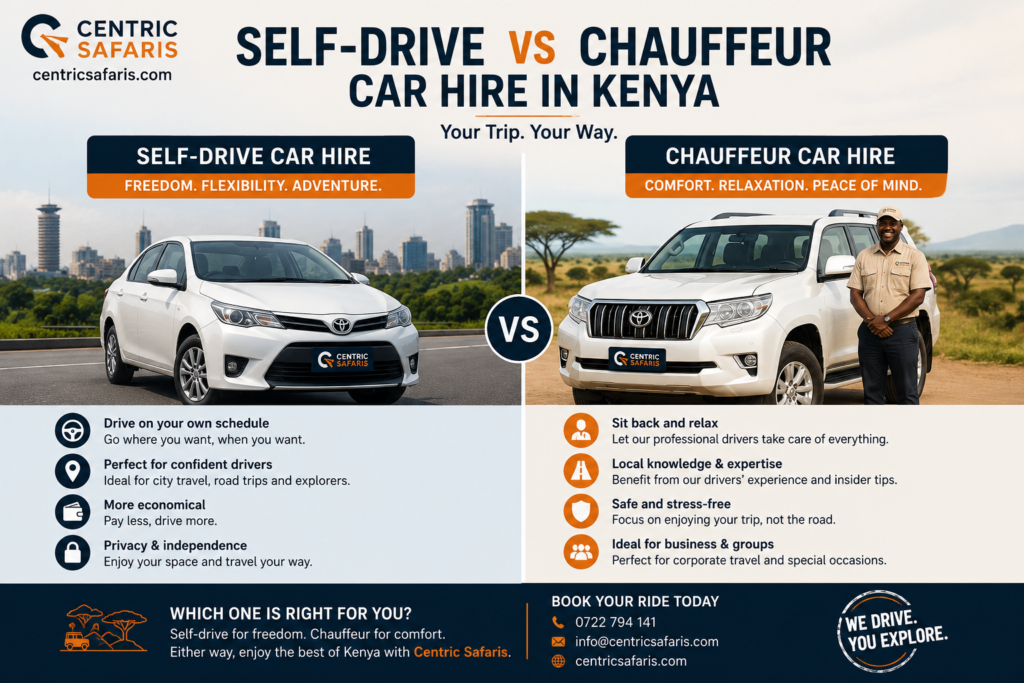
Lean toward self-drive if:
- You’re staying mainly within Nairobi and feel confident with roundabouts and left-hand traffic
- Your trip is short (1–5 days) and doesn’t include unpaved park roads
- You’d rather set your own pace than coordinate around a driver’s schedule
Lean toward chauffeur-driven car rental in Kenya if:
- Your route includes the Maasai Mara, Amboseli, or other unpaved park roads
- You’re unfamiliar with Kenyan driving norms or would rather not navigate checkpoints solo
- Your trip is business-focused and you’d rather work from the back seat than watch the road
Plenty of travelers land somewhere in between, and a hybrid booking is entirely normal: self-drive for the Nairobi portion of a trip, switching to a chauffeur-driven 4×4 once the itinerary turns toward the parks. Rental companies that specialize in safari logistics can usually arrange this switch mid-trip rather than requiring two entirely separate bookings.
5. Rethinking Price: Cost Per Kilometer, Not Just Cost Per Day
A daily rate alone is a poor way to compare car rental in Kenya, because different vehicles cover very different distances on the same itinerary. A cheap sedan quote can end up costing more per kilometer than a pricier 4×4 once fuel efficiency and realistic trip distance are factored in.
| Vehicle | Self-Drive Daily Rate | Typical Weekly Distance* | Approx. Cost per KM |
| Economy Sedan | $45/day | ~400 km (city use) | ~$0.70/km |
| Standard SUV | $80/day | ~900 km (mixed routes) | ~$0.47/km |
| 4×4 Land Cruiser | $150/day | ~1,100 km (safari loop) | ~$0.67/km |
| Minivan (7–9 seats) | $120/day | ~900 km (group trip) | ~$0.58/km |
*Distances are illustrative examples over a 7-day rental, not guarantees — always ask for a written quote with your actual planned route before booking. The point of this table isn’t the exact figures; it’s the habit of asking for cost-per-kilometer, not just cost-per-day, when a route involves real distance.
This reframing matters most for safari routes, where a 4×4 covering 1,100km over a week can end up cheaper per kilometer than a sedan technically quoted at a lower daily rate but covering far less ground, and considerably safer given the terrain involved. When comparing two quotes for the same trip, ask each company for their estimate of total distance covered — it turns an apples-to-oranges price comparison into an apples-to-apples one.
6. Fleet Suitability at a Glance
Cross-referencing this table against the neighborhood and terrain notes above is usually enough to shortlist one or two realistic vehicle options before you ever request a quote.
| Vehicle | Seats | Best Terrain | Ideal Trip Length |
| Economy Sedan | 4 | Paved city roads | 1–5 days |
| Standard SUV | 5 | Paved plus light gravel | 3–10 days |
| 4×4 Land Cruiser (pop-up roof) | 5–7 | Unpaved park roads | 4–14 days |
| Minivan / People Carrier | 7–9 | Paved, mixed routes | 3–10 days |
| Luxury Sedan / SUV | 4–5 | Paved, executive routes | 1–3 days |
7. The Rental Glossary: Words You’ll See on Every Quote
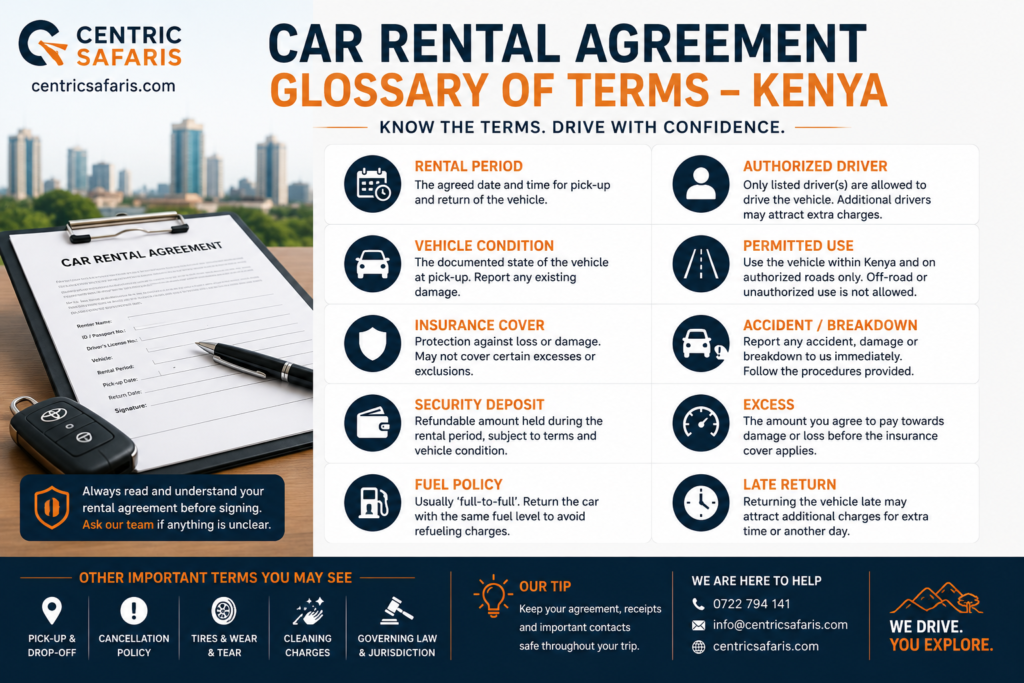
Car hire quotes in Kenya use a handful of terms that aren’t always explained clearly. Here’s what they actually mean.
CDW (Collision Damage Waiver) — A cover option that limits your financial liability for damage to the rental vehicle, usually down to a set excess amount rather than the full repair cost.
Excess — The amount you’d still have to pay out of pocket toward damage or theft before insurance covers the rest — ask for this figure explicitly, since it varies widely between companies.
Full-to-Full — The standard fuel policy: you collect the car with a full tank and return it full, covering fuel yourself in between.
One-Way Fee — An additional charge for returning the vehicle to a different city than where you collected it, covering the cost of repositioning the car.
IDP (International Driving Permit) — A translated supplement to your home driving licence, required by most self-drive rentals for non-Kenyan licence holders.
Mileage Cap — A daily or total distance limit built into some rental agreements, with an extra per-kilometer charge once you exceed it.
Security Deposit — A refundable hold — cash or card — taken at pickup to cover potential damage, fines, or unpaid fuel, released after a clean return inspection.
Chauffeur Allowance — A daily fee covering a driver’s meals and, on multi-day trips, accommodation — separate from the vehicle’s own daily rate.
Comprehensive Cover — An upgraded insurance tier that typically reduces your excess further and extends protection to theft and certain third-party claims, usually offered as a per-day add-on.
Repatriation Clause — A term covering who pays to recover the vehicle if it becomes stuck or immobilized somewhere the standard roadside assistance can’t reach, common in safari-specific rental agreements.
8. Documents and Paperwork Nobody Explains Properly
Beyond the standard checklist — a valid driving licence, an International Driving Permit for most non-Kenyan licences, and a passport or national ID — a few details rarely get spelled out clearly.
- Some companies accept an English-language licence from certain countries without an IDP; this is the exception rather than the rule, so confirm it in writing rather than assuming
- Security deposits are usually held as a card authorization rather than a cash charge, and the hold can take several business days to release after your return
- Most companies set a minimum rental period, often one full day, even if you only need the car for a few hours
- Chauffeur-driven bookings waive almost all of the self-drive paperwork, since a licensed local driver operates the vehicle on your behalf
- Long-term rentals for expatriates and NGO staff often require a signed corporate letter or work permit reference in addition to the standard identification, since billing is frequently arranged monthly against an institutional account
9. Three Real Travelers, Three Rental Choices
The Solo Backpacker
Landing at JKIA with a two-week loose itinerary and a tight budget, a solo backpacker typically opts for a self-drive economy sedan for the Nairobi leg, then switches to a shared chauffeur-driven 4×4 booking for the safari portion of the trip, splitting the driver and vehicle cost with other travelers rather than hiring a 4×4 solo for two weeks. The switch happens specifically at the point where the itinerary leaves paved roads — a detail worth planning around rather than defaulting to one vehicle for the entire trip.
The Family of Five
With young children, luggage, and a 10-day loop through Nakuru and Naivasha planned, a family of five is usually better served by a single self-drive SUV or minivan than two smaller cars — cheaper per person, and simpler logistically than coordinating two vehicles across the same route. The deciding factor here is usually boot space and seatbelt count rather than off-road capability, since the Rift Valley route in this example stays mostly on tarmac.
The Corporate Team of Three
Visiting Nairobi for a week of back-to-back meetings across Westlands, Upper Hill, and Gigiri, a small corporate team typically books an executive chauffeur-driven sedan on a weekly corporate rate, prioritizing punctuality and the ability to work between meetings over price alone. For this traveler type, a documented insurance excess and a dependable driver matter more than the daily rate itself, since a missed meeting costs far more than the difference between two rental quotes.

10. International Chains vs. Local Independents vs. Safari Specialists
| Factor | International Chain | Local Independent | Safari Specialist |
| Price | Generally higher | Often the most competitive | Mid-to-higher, reflects specialist fleet |
| Fleet range | Wide, standardized | Variable by company | Purpose-built 4x4s, pop-up roofs |
| Local road knowledge | Moderate | Often strong | Very strong on park routes |
| Safari-specific extras | Limited | Varies | Camping gear, spotter guides, park logistics |
| Booking flexibility | Standardized policies | Often negotiable | Often tailored to your itinerary |
None of these three categories is universally “best” — an international chain suits travelers who want standardized policies wherever they go, while a safari specialist earns its higher rate through route-specific fleet and local logistics that matter once you’re off the tarmac.
Local independents often sit in an underrated middle ground: smaller fleets mean less choice on any given day, but many operate with lower overheads and more room to negotiate a weekly or monthly rate, particularly for long-stay expatriate and NGO bookings that a large chain would quote at a fixed, less flexible price.
11. When to Book: A Seasonal Calendar for Kenya Car Hire
| Season | Months | Recommended Booking Lead Time | Price Trend |
| High season (wildebeest migration) | July – October | 4–8 weeks ahead | Highest |
| Festive peak | December – January | 6+ weeks ahead | High |
| Short rains | November | 1–2 weeks ahead | Moderate |
| Green season | March – May | Often available same-week | Lowest |
Booking early during the July–October migration season isn’t just about securing a lower rate — it’s about vehicle availability, since 4×4 safari fleets in particular sell out well ahead of peak dates.
The green season carries an underrated advantage beyond price: parks are noticeably quieter, and landscapes are at their most lush. The trade-off is a higher chance of short, intense afternoon downpours, which is exactly the scenario the earlier driving-culture section warns about on unpaved park roads.
12. If Something Goes Wrong: Accidents, Breakdowns, and Theft
Most rentals go smoothly, but knowing the process in advance removes a lot of stress if something doesn’t.
- For a breakdown, call the rental company’s emergency line first — most include 24/7 roadside assistance, and attempting a roadside repair yourself can affect your cover
- For an accident, prioritize safety, then contact the rental company and, for anything beyond very minor damage, the police, since an official report is usually required for an insurance claim
- For theft, report to the nearest police station immediately and obtain a written report — this is typically a requirement before any theft-related insurance cover applies
- Photograph everything at the scene where safely possible; this protects you as much as it protects the rental company
Whatever the incident, keep copies of every document generated — police abstract, rental company incident form, photos, and any repair estimate. Insurance claims in Kenya move considerably faster when the paperwork trail is complete from the outset, rather than assembled after the fact from memory.
13. Why Travelers Choose Centric Safaris
Centric Safaris was built around exactly the kind of decisions this handbook walks through — matching the right vehicle, pickup point, and driving option to your actual route, rather than quoting a flat daily rate and leaving the rest to you. Whether you’re weighing self-drive against chauffeur-driven car rental in Kenya, our team talks through your itinerary before naming a price.
For safari routes specifically, our 4×4 Land Cruiser hire fleet is maintained for exactly the park conditions described above. Landing at JKIA or Wilson? Our airport car hire and pickup service gets you moving within minutes. Prefer a fully planned trip rather than assembling one yourself? Browse our tailor-made Kenya safari packages.
Still deciding which option in this handbook fits your trip? Get in touch with our team and we’ll build a quote around your actual route.
14. Frequently Asked Questions
-
Do I need cash, or can I pay online for car hire in Nairobi?
Most established rental companies accept online card payment and a card-based security deposit hold, though smaller independents may still prefer cash for part of the payment — confirm accepted methods before you arrive.
-
What’s the difference between a security deposit and rental excess?
The security deposit is a refundable hold taken upfront and released after a clean return; the excess is the amount you’d actually forfeit toward a claim if damage or theft occurs during the rental.
-
Can I take a rental car across the Kenya–Tanzania border?
Some companies allow cross-border travel with additional paperwork, insurance extensions, and a permit fee; this needs to be arranged in advance and is not available with every rental agreement.
-
Are automatic transmission vehicles available for car hire in Kenya?
Yes, automatic options exist across most vehicle categories, though manual transmission is still more common in the entry-level economy segment — specify your preference when requesting a quote.
-
What should I do if I get a flat tyre on a safari route?
Pull well off the road if possible, use the vehicle’s spare and jack if you’re confident doing so, and call the rental company’s assistance line — most safari-ready 4x4s carry a full-size spare specifically for this reason.
-
Is there a curfew or restriction on driving at night in Kenya?
There’s no nationwide legal curfew for private vehicles, but night driving outside towns is strongly discouraged due to unlit potholes, wandering livestock, and reduced visibility on rural and park-adjacent roads.
-
Can I hire a car in Nairobi without a credit card?
Some companies accept a cash deposit or mobile money in place of a card hold, though terms vary — this is worth confirming directly, since many international chains require a card specifically.
-
What’s the shortest rental period a company will accept?
Most companies set a one-day minimum, even for a booking of just a few hours, though hourly executive chauffeur bookings are sometimes available for airport transfers or single-meeting trips.
-
Do I need a special permit to drive into Kenya’s national parks?
The rental vehicle itself doesn’t need a special road permit, but each park charges its own entry and vehicle fees separately from your car hire agreement — these are typically arranged at the gate or in advance through a safari operator.
-
Can two people share driving duties on the same self-drive rental?
Yes, most companies allow an additional named driver on the same agreement, usually for a small added fee, provided that second driver also meets the licence and age requirements.
15. Closing Thought: Match the Vehicle to the Route, Not the Rate
The cheapest quote on the page rarely tells you whether a car can handle the road you’re actually planning to drive, what the excess really is, or who to call if something goes wrong at 6pm on a Friday outside Naivasha. Car hire in Nairobi and car rental in Kenya work best when the neighborhood pickup, vehicle type, driving option, and insurance are chosen together, around your specific route — not assembled after the fact from whichever listing had the lowest daily number.
Centric Safaris quotes every booking this way, from a single day inside Nairobi to a full multi-city loop through the Rift Valley and the Mara.
If this handbook has done its job, you should now have a working answer to the question it opened with — what kind of trip this actually is — along with a rough sense of vehicle, neighborhood, season, and cost per kilometer to match it. The remaining step is simply putting that plan in front of a company that will confirm it in writing rather than leave the details for later.